
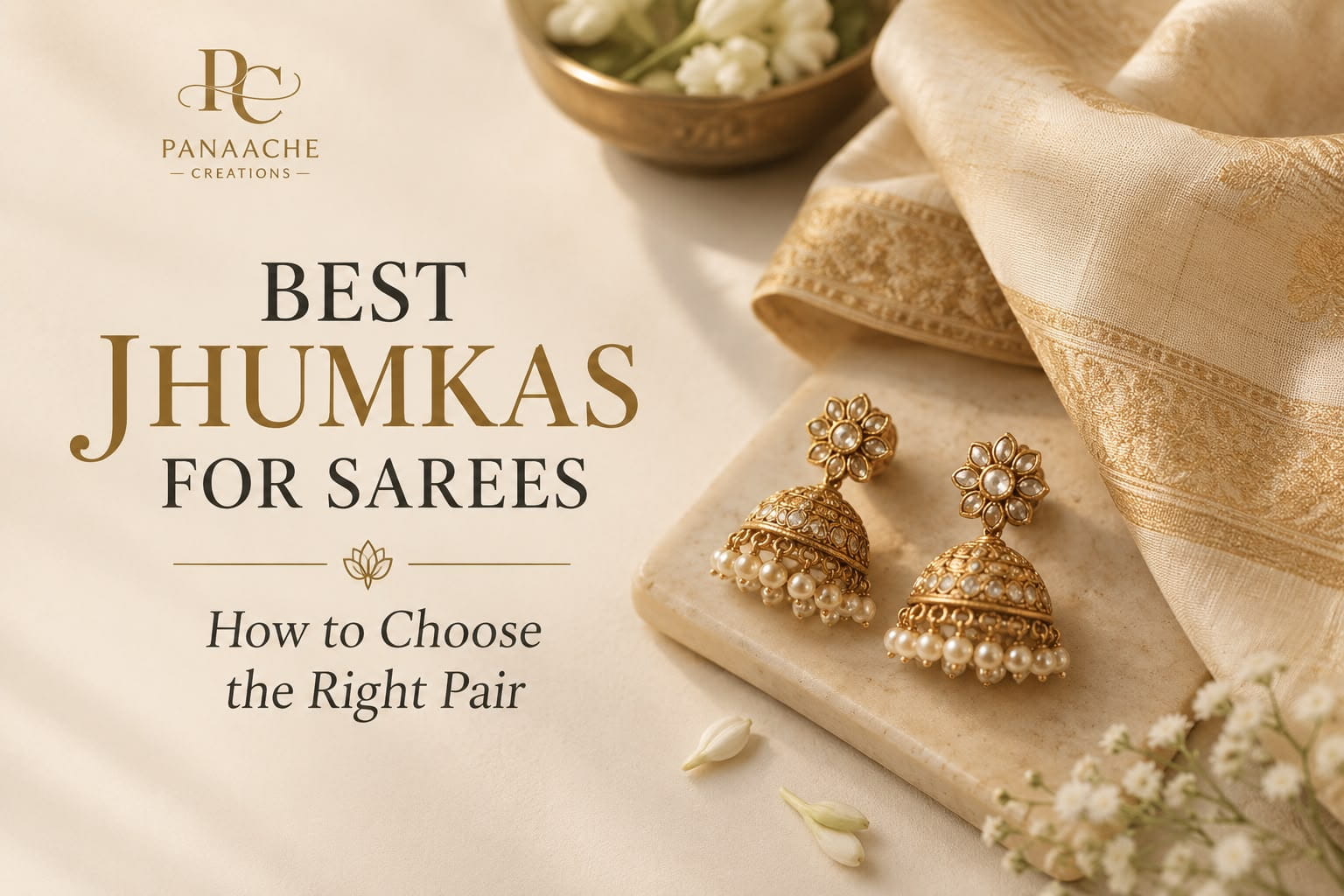
Best Jhumkas for Sarees: How to Choose the Right Pair
A saree already has a charm of its own, but the right pair of jhumkas can bring the whole look together. Whether you are wearing a silk saree for a wedding, a lightweight cotton saree for a family gathering, or a festive saree for Diwali, earrings can change the way the outfit feels.
Jhumkas are especially popular with sarees because their traditional shape works beautifully with Indian silhouettes. But choosing the right pair is not simply about picking the biggest or most decorated design. The saree’s fabric, colour, blouse, occasion and even your hairstyle can make a difference.
If you are looking for the best jhumkas for sarees, here are some practical things to consider before choosing a pair.
Why Jhumkas Look So Good with Sarees
There is something naturally graceful about pairing a saree with jhumkas.
The rounded shape of a traditional jhumka complements the flowing drape of a saree without making the outfit look too complicated. You can wear a simple pair with an everyday saree or choose a more detailed design when dressing up for a wedding or festive celebration.
Jhumkas also give you plenty of styling options. You can find small, delicate designs as well as large statement pieces with beads, stones, pearls and intricate detailing.
The trick is finding a pair that works with your saree rather than competing with it.
1. Traditional Gold-Toned Jhumkas for Silk Sarees
Silk sarees already carry a rich, traditional appearance, so classic gold-toned jhumkas are an easy combination.
They work particularly well with sarees such as Kanjivaram, Banarasi and other richly woven traditional styles.
You can choose a simple dome-shaped jhumka for an elegant look or go for a more detailed design if the saree is relatively simple.
If your saree already has a heavy zari border, you do not necessarily need extremely elaborate earrings. A beautifully crafted traditional jhumka can be enough.
2. Antique-Finish Jhumkas for a Traditional Look
Antique-finish jhumkas have a slightly old-world character that works beautifully with traditional sarees.
They can pair especially well with handloom sarees, cotton sarees and sarees featuring earthy or deeper colours.
An antique finish can also be a good choice when you want your jewellery to look traditional without appearing overly shiny.
Pair them with a neatly tied hairstyle, a small bindi and minimal additional jewellery for a classic Indian look.
3. Pearl Jhumkas for Elegant Saree Outfits
If you prefer something softer and more graceful, pearl-detail jhumkas are worth considering.
Pearls can work particularly well with pastel, white, cream, blush and other lighter-coloured sarees. They can also soften the appearance of a heavily embroidered outfit.
A pearl jhumka does not always need to be completely traditional. Contemporary designs with small pearl drops can work with both traditional and Indo-Western sarees.
They are also a useful choice when you want earrings that can be worn for more than one occasion.
4. Statement Jhumkas for Wedding Sarees
Wedding outfits give you more room to experiment with larger jewellery.
If you are wearing a heavily embellished saree, a statement jhumka can become the main focus around your face. Look for designs with layered domes, stones, beads or detailed motifs.
However, keep the rest of your jewellery in mind.
If you are already wearing a large necklace, maang tikka and bangles, extremely oversized earrings may make the overall look feel crowded.
Sometimes a medium-sized statement jhumka creates a more balanced appearance than the largest pair you can find.
5. Temple-Inspired Jhumkas for Traditional Sarees
Temple-inspired jewellery has a strong connection with traditional Indian dressing and can look beautiful with silk and festive sarees.
Jhumkas featuring traditional motifs, floral details or deity-inspired craftsmanship can add a distinctive character to the outfit.
These designs are particularly suitable when you want your jewellery to feel deeply traditional rather than simply decorative.
If your saree has traditional motifs or a rich woven border, temple-inspired jhumkas can complement those details naturally.
6. Lightweight Jhumkas for Everyday Sarees
Not every saree needs heavy jewellery.
If you regularly wear cotton, linen or lightweight sarees, choose jhumkas that are comfortable enough for everyday use.
Small or medium-sized handmade jhumkas can add personality to a simple saree without making the outfit feel overdressed.
This is also where lightweight designs become especially useful. You can wear them to work, casual gatherings, family lunches or small celebrations without constantly thinking about the weight of your earrings.
7. Colourful Jhumkas for Plain Sarees
A plain saree gives you more freedom with accessories.
If you are wearing a solid-colour saree, colourful jhumkas can introduce an interesting detail around the face.
For example, a deep blue saree can work with contrasting or complementary coloured stones, while a neutral saree gives you plenty of room to experiment.
You do not have to match the earrings exactly with the saree. Sometimes choosing a colour already present in the blouse or border creates a more natural connection.
8. Silver Jhumkas for Cotton and Handloom Sarees
Silver-toned jhumkas can look especially beautiful with cotton and handloom sarees.
They bring a slightly understated, earthy feel that works well for daytime occasions.
If you prefer a less traditional gold-heavy jewellery look, silver or oxidised jhumkas can be an interesting alternative.
They can also be styled with simple blouses and minimal accessories, allowing the saree’s texture and weave to remain visible.
9. Jhumkas with Coloured Stones and Beads
For festive occasions, jhumkas with colourful stones or beads can add a little more personality to your saree look.
These designs are particularly useful when your saree has multiple colours.
Instead of trying to match every colour, choose a jhumka that picks up one or two shades from the saree or blouse.
This creates coordination without making the outfit look overly matched.
How to Choose Jhumkas According to Your Saree Fabric
The fabric of your saree can influence the type of jhumka that looks most natural.
Silk sarees: Traditional gold-toned, temple-inspired or detailed jhumkas.
Cotton sarees: Lightweight, oxidised, silver-toned or handcrafted jhumkas.
Georgette and chiffon sarees: Delicate, pearl or contemporary jhumkas.
Banarasi sarees: Traditional, antique or richly detailed jhumkas.
Linen sarees: Minimal, handcrafted or earthy-looking jhumkas.
These are not strict rules. Personal style always comes first, but the fabric can give you a useful starting point.
Consider Your Blouse Before Choosing Earrings
The blouse is often overlooked when selecting jewellery.
If your blouse has heavy embroidery, sequins or an elaborate neckline, you may want slightly simpler earrings.
If the blouse is plain, statement jhumkas can add the detail that the outfit needs.
Also consider the neckline. A high-neck or heavily decorated blouse may look better with earrings as the main accessory, while a simpler neckline gives you more freedom to add a necklace as well.
Choose Jhumka Size According to Your Comfort
Large jhumkas can look stunning, but size should never be the only deciding factor.
Check the dimensions and approximate weight before buying, especially when shopping online.
If you are going to attend a wedding or festival for several hours, comfort becomes even more important.
A beautiful pair that feels too heavy after an hour may end up spending most of its life inside your jewellery box.
If you are not accustomed to wearing large earrings, a medium-sized jhumka can give you a statement look without being difficult to wear.
Your Hairstyle Can Change the Look
Jhumkas become more noticeable when your hair is pulled back.
A bun, braid or ponytail can create a clean frame around the face and allow detailed earrings to stand out.
With open hair, smaller jhumkas may sometimes be more practical because very large earrings can get caught in the hair.
This does not mean you need to follow a particular hairstyle. Think about how visible and comfortable you want the earrings to be.
Handmade Jhumkas for a More Individual Look
If you want something beyond mass-produced designs, handmade jhumkas can be an interesting option.
Handcrafted pieces may have small differences in texture, shape or finishing because they are made individually. For many people, these subtle variations are part of the appeal.
When buying handmade jhumkas online, look for clear information about materials, dimensions, weight and care.
Good product photography is helpful, but the written product details are equally important when you cannot physically examine the earrings before purchasing.
What to Check Before Buying Jhumkas Online
A product photograph can make almost any jewellery piece look attractive. Before ordering, take a closer look at the practical details.
Check:
- Exact dimensions
- Approximate weight
- Materials used
- Earring closure
- Product photographs from different angles
- Customer reviews
- Care instructions
- Shipping information
- Return or exchange policy
If something important is missing, contact the seller before placing the order.
A reliable jewellery business should be willing to provide clear information about its products.
How to Wear Jhumkas Without Overdoing the Jewellery
Jhumkas can easily become the main attraction of a saree outfit.
If your earrings are large and detailed, you may not need a heavy necklace. A simple chain, bangles or a watch can be enough.
For a smaller jhumka, you can add a necklace or other traditional jewellery if the occasion calls for it.
A useful rule is to look at the complete outfit in the mirror rather than judging each jewellery piece separately.
Sometimes removing one accessory makes the entire look feel more polished.
Jewellery Colours That Work Well with Sarees
There are no fixed colour rules, but some combinations are naturally easy to style.
- Red saree: Gold, antique or contrasting stone jhumkas
- Green saree: Gold, antique or traditional jhumkas
- Blue saree: Silver, gold or colourful jhumkas
- Pink saree: Pearl, gold or delicate colourful designs
- Black saree: Silver, oxidised or statement jhumkas
- White or cream saree: Gold, pearl or colourful jhumkas
- Yellow saree: Gold, antique or earthy-toned designs
The blouse and saree border should also be considered before making the final choice.
How to Care for Your Jhumkas
Once you find a pair you love, proper storage can help keep it in good condition.
After wearing the earrings, gently wipe away moisture or makeup with a soft cloth when appropriate for the material.
Keep them somewhere dry and avoid storing different pieces in a way that allows them to scratch or tangle with one another.
Follow the specific care instructions provided by the jewellery seller, particularly for plated, stone-studded or handcrafted pieces.
Good care is especially important if you want to bring the same jhumkas out for future weddings and festive occasions.
Final Thoughts
The best jhumkas for sarees are not necessarily the largest, most expensive or most heavily decorated ones.
The right pair should make sense with the saree, occasion and your personal style. A traditional gold jhumka can look beautiful with silk, an oxidised pair can complement a handloom saree, and a lightweight handmade design can become an easy everyday favourite.
Before buying, look beyond the photograph. Check the size, weight, materials, reviews and return policy, especially when shopping online.
Most importantly, choose a pair that you feel comfortable wearing. When your jewellery feels right, you do not have to think too much about it—the saree, the earrings and the person wearing them simply come together.